
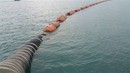


For dredging and marine slurry transportation projects, the comparison between HDPE pipe and rubber hose is frequently simplified into a basic material-versus-material evaluation. Many procurement teams refer only to catalog indexes including corrosion resistance, unit price and theoretical service life, ignoring the real-world mechanical boundary conditions that decide on-site service performance. Neither material holds universal superiority. Their practical value hinges on motion amplitude, load circulation, installation environment and available on-site maintenance capacity. Misapplied materials will trigger frequent joint leakage, fatigue fracture and unplanned shutdowns, even when product specifications fully satisfy paper-form requirements.
HDPE dredging pipe demonstrates outstanding advantages in static or low-movement working scenarios. After hot-melt fusion welding, the pipeline forms an almost continuous whole structure, greatly cutting the quantity of leakage-prone connecting points. Its smooth inner wall lowers slurry friction loss, and it delivers stable anti-corrosion performance facing seawater, silt and most sediment mixtures. It fits perfectly for long-distance fixed-layout discharge pipelines laid along river banks, seabed-laid conveying sections and floating pipelines supported by pontoons with limited swing. Under stable stress distribution, the pipe body itself rarely suffers damage; nearly all failures concentrate on welding seams, flange transition interfaces and support positions.

Nevertheless, HDPE has clear application limits that cannot be overlooked. This rigid plastic material cannot withstand repeated cyclic bending. When installed near dredger stern outlets or waters with heavy wave agitation, unabsorbed displacement stress will accumulate on welds and flanges. Poor-quality field welding amplifies this risk. Defects produced by misalignment, insufficient heating or improper cooling do not show up immediately after construction; they gradually expand under pressure cycling and wave impact, and eventually cause cracking after weeks or months of operation. HDPE is also not fit for working conditions requiring frequent disassembly, relocation and repeated splicing. Frequent dismantling will damage flange surfaces and welded joints, sharply shortening the usable cycle.

Dredging rubber hoses fill the application gaps of HDPE by virtue of structural flexibility. Multi-layer composite structures composed of wear-resistant rubber, fabric layers and steel wire skeletons can absorb relative displacement generated by vessel sway, tidal fluctuation and water flow surges. For the short connection segment between dredger stern and floating pipeline, as well as temporary construction pipelines that need frequent route adjustment, flexible hoses release mechanical stress instead of transferring it to rigid joints. For urgent short-term projects with tight construction schedules, rubber hose also features fast deployment and convenient layout adjustment.
Flexibility is not equivalent to invulnerability. Rubber hoses transfer stress inward to reinforcement layers and end fittings. Long-term scouring of abrasive slurry, pressure surges and thousands of bending cycles will produce invisible internal damage. Internal delamination and steel wire corrosion often cannot be identified through simple surface visual inspection. Project teams must judge material selection by analyzing the whole-site operating boundary, rather than relying solely on basic material performance parameters. Clarifying motion range, frequency of disassembly and environmental load lays the foundation for reasonable material segmentation layout.


