

Reclaimer teeth, as a core component of cutter suction dredgers, play a crucial role in cutting and crushing underwater materials during dredging operations. The quality of their performance directly affects the efficiency and cost of dredging operations, as well as the service life of the equipment. This article will conduct an in - depth analysis of reclaimer teeth from the aspects of structural design, material selection, manufacturing processes, and maintenance key points, helping readers gain a comprehensive understanding of this key technology.

I. Structural Design of Reclaimer Teeth
1. Basic Shapes and Functions
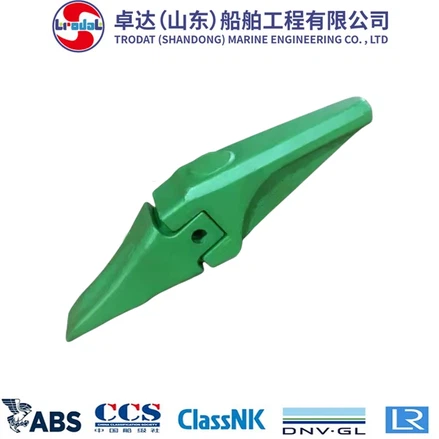
Typical reclaimer teeth feature an elongated conical or wedge - shaped design. This design effectively reduces insertion resistance, enabling the tooth tips to smoothly penetrate layers of sediment and rock. Some reclaimer teeth are equipped with serrated structures at the cutting edges, significantly enhancing their crushing capabilities, especially when dealing with high - hardness materials. The diverse shapes of reclaimer teeth are determined by different working environments and material characteristics. For example, in soft soil strata, a more pointed tooth shape can be adopted to improve cutting efficiency. In hard rock strata, reclaimer teeth with a thick and robust structure and high wear resistance are required.
2. Installation Methods and Connection Structures
The common installation methods for reclaimer teeth include welding and bolt connection. Welded reclaimer teeth form an integral part with the cutter head, providing a firm connection that can withstand large impact loads. However, when replacement is necessary, cutting and re - welding are required, which is a complex and time - consuming process. Bolt - connected reclaimer teeth are convenient for disassembly and replacement, improving maintenance efficiency. Nevertheless, strict requirements are placed on the strength and tightness of the bolts. To prevent bolts from loosening during underwater operations, special anti - loosening devices such as spring washers and self - locking nuts are usually employed.

II. Material Selection and Performance Optimization
1. Characteristics of Commonly Used Materials
Reclaimer teeth operate in extremely harsh environments, demanding materials with high wear resistance, corrosion resistance, and impact resistance. Currently, commonly used materials mainly include high - manganese steel, chromium - molybdenum alloy steel, and cemented carbide. High - manganese steel exhibits good machinability and impact toughness. When subjected to impact loads, the surface undergoes work hardening, forming a high - hardness hardened layer, thereby enhancing wear resistance. Chromium - molybdenum alloy steel features high strength and hardness, along with excellent hardenability and tempering stability, making it suitable for manufacturing components that bear heavy loads and wear. Cemented carbide has extremely high hardness and wear resistance but relatively low toughness. It is typically used to manufacture the tooth tips to improve the overall performance of reclaimer teeth.
2. Optimization and Innovation of Materials
To further enhance the performance of reclaimer teeth, materials scientists are constantly exploring new materials and processes. For example, by adding trace elements such as vanadium, titanium, and niobium to the alloy, the grain structure can be refined, improving the strength and toughness of the material. In addition, surface treatment technologies such as thermal spraying, carburizing, and nitriding have been widely applied. These technologies form a high - hardness and wear - resistant coating on the surface of reclaimer teeth, effectively extending their service life.
III. Manufacturing Processes and Quality Control
1. Forming Processes
The manufacturing of reclaimer teeth usually involves forging or casting processes. The forging process can refine the grain structure during the plastic deformation of metal materials, improving the density and mechanical properties of the materials. However, the forging process requires high - end equipment and molds, resulting in relatively high costs. The casting process has the advantages of high production efficiency and low cost, and it can produce reclaimer teeth with complex shapes. Nevertheless, defects such as pores and shrinkage cavities are likely to occur during the casting process, affecting product quality. To address this issue, precision casting processes such as investment casting and lost - foam casting are often adopted to improve the dimensional accuracy and surface quality of castings.
2. Heat Treatment Processes
Heat treatment is a crucial step in improving the performance of reclaimer teeth. Through heat treatment processes such as quenching and tempering, the microstructure of the material can be adjusted to obtain the desired mechanical properties. For example, after water toughening treatment, high - manganese steel can obtain a single austenite structure, featuring good toughness and work - hardening ability. For chromium - molybdenum alloy steel, a reasonable quenching and tempering process can improve the matching of its strength, hardness, and toughness. During the heat treatment process, strict control of parameters such as heating rate, holding time, and cooling rate is the key to ensuring product quality.
3. Quality Inspection and Control
To ensure the quality of reclaimer teeth, strict quality inspections are required. Commonly used inspection methods include visual inspection, dimensional measurement, hardness testing, metallographic analysis, and non - destructive testing. Visual inspection mainly focuses on observing whether there are defects such as cracks, sand holes, and pores on the surface of reclaimer teeth. Dimensional measurement ensures that products meet design requirements. Hardness testing checks whether the hardness of the material meets the standard. Metallographic analysis observes whether the microstructure of the material is normal. Non - destructive testing uses methods such as ultrasonic testing, magnetic particle testing, and penetrant testing to detect internal defects. By establishing a sound quality control system and monitoring the entire production process, problems can be identified and solved in a timely manner, ensuring the stability of product quality.
IV. Maintenance and Troubleshooting
1. Key Points of Daily Maintenance
Regularly inspect the wear condition of reclaimer teeth and adjust or replace them in a timely manner according to the degree of wear. Keep the tooth body and installation parts clean to prevent sediment and dirt from entering the connection parts, which may affect the normal operation of the equipment. For bolt - connected reclaimer teeth, regularly check the tightness of the bolts to prevent loosening. In addition, pay attention to observing the working status of reclaimer teeth during operations. If abnormal vibrations, noises, etc. are detected, stop the machine immediately for inspection.
2. Common Faults and Troubleshooting Methods
Common faults of reclaimer teeth include excessive wear, breakage, and loosening. Excessive wear may be caused by improper material selection, harsh working environments, or incorrect operation methods. The solution is to select appropriate materials based on actual conditions, optimize operation parameters, and improve operating skills. Breakage is usually due to material quality issues, improper heat treatment, or excessive impact loads. It is necessary to strengthen material inspection and heat treatment process control and avoid overloading operations. Loosening may be caused by insufficient bolt tightening force or failure of anti - loosening devices. In this case, re - tighten the bolts and replace the failed anti - loosening devices.