
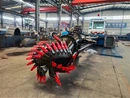

The bucket dredger is one of the mechanical dredgers.
A bucket dredger is a stationary dredger that is equipped with a continuous chain of buckets, which
are carried through a structure, the ladder.
This ladder is mounted in a U-shaped pontoon.
The drive of the bucket chain is on the upper side. The bucket dredger is anchored on six anchors.
During dredging, the dredger swings round the bow anchor by taking in or paying out the winches on
board. The buckets, which are filled on the underside, are emptied on the upper side by tipping their
contents into a chute along which the dredged material can slide into the barges moored alongside.
The chain is driven by the so called upper tumbler at top of ladder frame, which is connected either
via a belt to the diesel or directly to an electro motor or hydro-motor.

ince 1960, bucket dredgers ( also called bucket line dredge(r) or bucket chain dredge(r)) that were
much used before the Second World War, have been almost entirely replaced by Backhoe dredgers or
trailing suction hopper dredgers and cutter suction dredgers. The reason for this is that the bucket
dredger, with its six anchors, is a big obstacle to shipping. Moreover maintenance costs are high and
the bucket dredger requires many highly skilled operatives. But above all, their production has not
kept pace with the increase in scale that has taken place in the suction dredgers.
Area of application
Bucket dredgers are only used in new or maintenance dredging projects when the initial depth of the
area to be dredged is too shallow for trailing suction hopper dredgers and the distances involved are
too long for hydraulic transport. For environmental projects, which require the dredging of ‘in situ
densities’, the bucket dredger is suitable peace of equipment.
When dredging for construction materials such as sand and gravel, or for minerals such as gold and
tin ores, bucket dredgers are still frequently used.

Bucket dredgers also come in a variety of types.
For example:
• Dredgers with or without the means of propulsion
• Dredgers with a conveyor belt system
• Dredgers with equipped with pumps
The maximum dredging depth is highly dependent on the size of the dredger. There are dredgers with
a maximum dredging depth of more than 30 metres. Such large dredgers the minimum dredging depth
is often 8 metres. Dredging in shallow water is certainly not the strongest point of the bucket dredger.
Bucket dredgers can be used in almost every type of soil, from mud to soft rock. When rock has been
fragmented by blasting, bucket dredgers are often used, because of their relative lack of sensitivity to
variations in the size of the stones.
Bucket dredgers can not be used in areas with waves and swell. Furthermore, because of the amount of
noise they produce, in urban areas they are often subject to restrictions in relation to the working time
or the permitted number of decibels measured at a specific distance from them.
The capacity of a bucket dredger is expressed in terms of the content of the buckets. The capacity of a
bucket can vary between 50 and 1200 litres.
Rock bucket dredgers often have a double set of buckets, the small rock buckets and the large mud buckets. This is in order to make better use of the power of
the dredger and to widen the range of its use.