
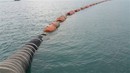

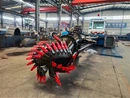

Suction Dredger
Suction dredger, also known as direct suction or fixed suction dredger. It is the simplest type of hydraulic dredger. It does not have a mechanical device to cut or dig the underwater soil layer. Instead, it relies on the suction force of the mud pump to directly suck the mud and then discharge it out.
1.2.4.1 Basic Principle of Suction Dredger
The working principle of the suction dredger is relatively simple. It mainly relies on the centrifugal mud pump installed on the dredger to produce a certain vacuum in its suction pipe. The mud suction head at the top of the suction pipe sucks up the silt, sand and other loose materials on the bottom of the water together with the water, and lifts the water out. Finally, through the discharge pipe of the mud pump, the sucked mud is discharged into the mud barge or transported to the specified mud dumping area. Figure 1.2.4-1 is a schematic diagram of a typical suction dredger.
1.2.4.2 Mud suction equipment
There is no soil excavation machinery on the suction dredger, and it does not have the ability to mechanically excavate and cut the underwater soil layer (but some ships are equipped with sand flushing nozzle equipment). Its mud suction device is mainly composed of a mud pump, a suction pipe, a mud suction head and a mud discharge pipe.
Mud suction head The mud
suction head is located at the front end of the suction pipe of the suction dredger, and its shape has a great influence on productivity. The earliest suction dredgers did not have a mud suction head at all. They only used the method of placing the suction pipe into the underwater soil layer to directly suck mud, and the suction port of the suction pipe was made into a circle [see Figure 1.2.4-2 (a)]. This suction condition is very poor, and very little mud can be sucked in, limited to the amount shown by the solid arrow in the figure.
The remaining dotted arrows sucked a large amount of clean water. In order to improve this undesirable situation, the suction port of the suction pipe was improved to an elliptical shape [see Figure 1.2.4-2 (b)]. This correspondingly expanded the range of mud suction and increased the concentration of mud. Later, a gap-type mud suction head was further developed [see Figure 1.2.4-2 (c)]. The height h of this suction head is very small, and the width b of the suction head is taken larger, so it can not only greatly increase the concentration of the sucked mud, but also make the bottom surface of the underwater trench smoother. This suction head is called a dustpan (or suction cup) suction head in the United States.

a-opening or movable cover; 1-suction pipe;
b-mud dispersing pipe with hole at the lower end; m-suction pipe bracket;
c-rotating mud discharge pipe (discharging mud to mud barge), usually with left and right ends; n-small hanger for lowering suction pipe;
d-rotating packing surface; o-guide pillow of elbow;
e-shore pipe joint; p-beam;
f-mud pump; q-hanger for beam and elbow;
g-motor; r-beam guide;
h-stone sinker; s-opening;
i-valve; t-front view of suction pipe bracket with pulley;
j-elbow; u-mud barge.
2. Flushing device
In order to improve the dredging efficiency of suction dredgers, some dredgers are equipped with a certain number of nozzles on their suction heads. The flushing system on the ship provides high-pressure water flow, which is sprayed to the underwater soil layer to achieve the purpose of using hydraulic power to loosen the silt in the soil layer around the suction head. Increase the concentration of the suction mud.
The flushing device on the ship is mainly composed of a flushing pump and related pipes and valves. Flushing pumps mostly use conventional centrifugal water pumps. In order to achieve sufficient stirring and loosening of the underwater soil layer of a certain hardness, high-pressure flushing is often used. The discharge water pressure of the flushing pump is generally not more than 10kg/cm².


