
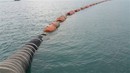

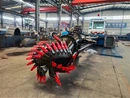

Ship types of winched suction dredgers
Winch suction dredger is one kind of hydraulic dredger, equipped with special equipment for dredging, such as reamer, bridge, suction and discharge pipeline, mud pump, positioning and transferring device and so on (see Fig. 3-1). Stranded suction dredger adopts fixed point, swing and step way, through the reamer and mud pump for dredging operations, and can through the pipeline independently complete the dredging-conveying the whole process of dredging operations. Stranded suction dredger usually use the installed power, production or discharge pipe diameter to characterize the size of the ship's construction capacity, with the depth of dredging, dredging width, row distance, unit production, operating sea state, etc. as its performance indicators.


Layout of a Typical Winch Suction Dredger
The working principle of the winch suction dredger: after the ship arrives at the working waters, the main steel pile is lowered, the two traversing winches on the deck or bridge are connected with the traversing anchor through the anchor cable through the traversing pulley and the anchors are thrown through the anchoring boat or anchoring pole, the winch suction dredger is positioned by using the main steel pile and the two traversing anchors, and the suction and discharge pipes on the ship are connected to the floating pipes above the water of the discharge pipe through the rotating bends on the ship's stern. Then the bridge is lowered by the bridge lifting winch, after the bridge is in the water, the mud pump and winch are activated, and the bridge continues to be lowered to the bottom of the water or reaches its maximum depth, and the two traversing winches retract and release the left and right traversing anchor cables, so as to make the stranded suction dredger swing in a circular arc around the main steel piles on the left and right sides. The reamer cuts the soil with left or right traverse on the bottom, and the mud pump sucks the soil cut by the reamer into the suction pipe, and then conveys it to the designated place through the suction and discharge pipeline and the discharge pipe by water power. When the required dredging depth is not reached at the end of one swing, the bridge is continued to be lowered and the winch suction dredger is swung in the opposite direction until the set dredging depth is reached. Then the main steel pile dolly traveling cylinder pushes the main steel pile dolly towards the stern direction to make the strand suction dredger move forward by one cutter position (step length), and repeat the above swing dredging operation. Until the main steel pile cart traveling cylinder stroke is finished, put down the auxiliary steel pile, lift the main steel pile, cart traveling cylinder toward the bow direction to retrieve the main steel pile cart, the main steel pile cart in place after the main steel pile is put down, lift the auxiliary steel pile, and repeat the above oscillating dredging operation again (see Figure 3-2). Winch suction dredger dredged material is mainly transported hydraulically through pipelines, but some winch suction dredgers also have a barge loading system.Until the set dredging depth is reached. Then the traveling cylinder of main steel pile dolly pushes the main steel pile dolly towards the stern direction to make the stranded suction dredger move forward by one cutter position (step length), and repeat the above swing dredging operation. Until the main steel pile cart traveling cylinder stroke is finished, put down the auxiliary steel pile, lift the main steel pile, cart traveling cylinder toward the bow direction to retrieve the main steel pile cart, the main steel pile cart in place after the main steel pile is put down, lift the auxiliary steel pile, and repeat the above oscillating dredging operation again (see Figure 3-2). Winch suction dredger dredged material is mainly transported hydraulically through pipelines, but some winch suction dredgers also have a barge loading system.

Figure 3-2 Vertical Swing Dredging Mode
Among the dredgers with different functions, the number of suction dredgers is the largest. A suction dredger can excavate almost all types of soil, from soft clay to hard rock, and is capable of directly transporting excavated material to a designated location through a discharge line using hydraulic power, with high operational efficiency, as well as precise excavation by positioning steel piles. As a result, the winch suction dredger has been the absolute mainstay of dredging and blowing works by virtue of its ability to adapt to a wide range of soils, precise excavation and high construction efficiency.
The soil quality of the excavation has a great influence on the design of the strand suction dredger, on the one hand, the determination of the power of the reamer needs to be based on the soil quality of the excavation; on the other hand, the reamer generates a huge force during the excavation, and part of the force is transmitted back to the ground through the bridge and the traversing anchor, while the other part is transmitted back to the ground through the ship's hull and the steel piles, so the design of the ship's hull, the steel piles, the bridge, the traversing winches and the traversing anchor are also related to the soil quality and the power of the reamer. . The range of winch power is 20 to 8500 kW.
The digging depth of suction dredger is usually limited, and the maximum digging depth of large suction dredger can be up to 25~45 m. On the one hand, the ship is positioned by steel piles, and the increase of water depth greatly increases the difficulty of designing the positioning steel piles; on the other hand, suction dredger digs through the reamer cutting, and the rigidity of the mounted reamer bridge has high requirements, and the deeper the water is, the harder the stiffness of the bridge is to be guaranteed.
The particle size of the soil and the conveying distance (row distance) determine the pressure of the required mud pump, which in turn determines the number of mud pumps required. In order to increase the conveying distance, most of the large suction dredgers are equipped with three mud pumps, which are connected in series to meet the requirements of long distance. Conveying distance in addition to the mud pump, but also with the transport of soil, in the mud pump configuration of a certain situation, the smaller the size of the soil, the lower the critical flow rate, the longer the conveying distance; conversely, the larger the size of the soil, the higher the critical flow rate, the closer the conveying distance.
As the steel piles are positioned for dredging in floating condition, the movement of the ship has a great influence on the force of the steel piles and the efficiency of the steering platform winch. When working under offshore wave or surge conditions, even if the wave compensator is installed on the winch suction dredger, it is obvious that it has more limitations than the rake suction dredger, and its working sea conditions are lower than that of the rake suction dredger.
The dredging yield of a suction dredger is usually expressed as the product of flow rate and concentration, which depends on the digging capacity of the reamer and the suction and transportation capacity of the mud pump. The digging capacity of the reamer refers to the yield of the reamer cutting substrate, considering that not all the cut substrate will enter the suction port, the reamer design cutting capacity needs to be higher than 20% to 30% of the dredging yield. The suction capacity of the mud pump is the flow rate of the mud pump and the suction concentration it can achieve. In larger dredging depth, only configure the bilge mud pump or deck mud pump suction dredger in order to avoid the mud pump cavitation and have to reduce the concentration of dredging, for this reason, with a large depth of dredging suction dredger is usually configured with underwater mud pumps, the use of underwater mud pumps under positive pressure to improve the concentration of dredging.
The dredging system of the winch suction dredger is composed as follows:
(1) Dredging system, including reamer, reamer shaft, gear box, electric or hydraulic motor and bridge.
(2) Suction and discharge system, including suction port, suction pipe, underwater mud pump, bilge mud pump or tandem pipe between deck mud pump and pump, discharge pipe, breathing valve, and rotating elbow.
(3) Positioning system, including main and auxiliary steel pile system or three-cable positioning system, traversing winch, traversing cable and anchor, guiding swing pulley.
(4) Bridge lifting system, including bridge lifting winch, lifting cable, lifting pulley set.
(5) Anchor pole system, including anchor pole, anchor winch, recovery winch, steel cable and so on.
(6) Barge loading system, including barge loading frame, tie-down winch and so on.
(7)Dredging monitoring system, including winch monitoring, mud pump monitoring, traversing winch monitoring, bridge lifting monitoring, main and auxiliary steel piles and cart position or three-cable positioning system monitoring, anchor rod monitoring, dredging profile and track display, dredging depth monitoring, flow rate and concentration and yield monitoring, draught and oil and water loading monitoring.


