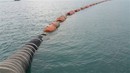

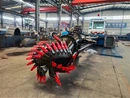

Dredging grab is a tool widely used in dredging projects, mainly for excavating and grabbing materials such as sediment and rocks at the bottom of water bodies. The following is a detailed introduction and principle analysis of the dredging grab.

I. Introduction to Dredging Grab
The dredging grab is widely applied in the dredging industry because of its simple ship - based structure and special operational capabilities. The grab - type dredger is a common type among many dredging construction machines, with a crane - style grabber installed on its deck. The grab is typically made of high - strength steel, featuring a large volume and high load - bearing capacity.
(1) Application Scenarios
It is mainly used for the construction of port basins, berths, and the excavation of hard - to - reach corners and tough soil that is difficult for other construction vessels to handle. For example, large - scale grab - type vessels play a crucial role in working conditions such as shallow water, navigable waterways, and rough seas.
In silt - removal projects, the grab - type dredger uses the grab on the steel cable to excavate and grab sediment, and then unloads the sediment into the mud hold or mud barge.
(2) Structural Features
The structure of the grab usually includes components such as the bucket body, pulley block, and steel cable. Research on the virtual prototype model of a 30 - cubic - meter dredging gravity grab (with a mass of 90 tons) shows that the main excavation force of the gravity grab comes from its own weight and the force - increasing structure of the pulley block.
The hull structure at the bottom of the grabber has high requirements for strength. For instance, for a dredger equipped with a 30 - cubic - meter grabber (the largest in - country volume), finite - element software needs to be used to calculate and analyze the strain - stress state of the hull structure at the bottom of the grabber, identify the key parts affecting the structural strength, and carry out optimization and targeted reinforcement.
II. Principles of Dredging Grab

(1) Mechanical Principles
Studying the excavation resistance of the dredging grab is the key to designing the grab, improving its structure, and achieving automatic horizontal excavation for grab - type dredgers. During the dredging process, theoretically, the excavation resistance includes two directions: horizontal and vertical. Theoretical excavation resistance can be studied by establishing a mathematical model. For example, based on the Rankine theory, the unit integration method can be used to calculate the excavation force process of the grab, determine the shape and position of the failure surface under the action of the active pressure FB and the passive pressure FE, and further obtain the functional expression of the relationship between the excavation force and the excavation parameters.
Through horizontal excavation experiments, the forces on the lifting rope and the closing rope are recorded, and then the horizontal and vertical excavation resistances are calculated based on the moment balance. When the theoretical calculations are in good agreement with the independent experimental results, the correctness of the research can be verified, providing technical support for horizontal excavation during the dredging process.
(2) Discrete Element Simulation
The discrete element theory is used to simulate and study the process of large - scale marine dredging and excavation by the grab. Through EDEM simulation of large - scale grabs, the force changes at all key parts of the grab can be obtained, providing a reference for reasonably determining parameters such as speed, hopper shape, and the structure of the arc - shaped discharge baffle, so as to design and improve the grab mechanism.
The simulation of the horizontal excavation force by the discrete element method (DEM) yields results consistent with those calculated by the unit integration method.
(3) Influencing Factors
When excavating under inclined conditions, through a large number of sand - slope excavation tests under different conditions, the shape and characteristic parameters of the excavation curve are analyzed, and the motion characteristics of the grab at different excavation stages are studied. Research shows that it is feasible to achieve horizontal excavation on slopes. The tension of the support rope has a decisive influence on the rotation of the grab during excavation on slopes. In addition, achieving horizontal excavation is also related to the operation method. Only when the excavation direction is parallel to the slope and the tension of the support rope is adjusted during the excavation process is it possible to achieve approximate horizontal excavation.
Taking the virtual prototype model of a 30 - cubic - meter dredging gravity grab as the research object, qualitative analysis of various working conditions is carried out in combination with the theory of dredging grabs and soil mechanics. Research shows that the gravity grab has a very large excavation reserve capacity, and its designed working conditions are more suitable for harsh construction environments such as relatively dense sand or broken rock. Installing a reasonable bucket - tooth structure can further reduce resistance and improve the excavation capacity. During the excavation process, an overly large initial excavation depth will have a significant impact on the flatness of horizontal excavation operations, and this should be avoided as much as possible during operation.
The dredging grab plays an important role in dredging projects. Its principles involve multiple aspects such as mechanical analysis, experimental research, and simulation. Through in - depth understanding of its structure and principles, the dredging grab can be better designed and applied, improving the efficiency and quality of dredging projects.
TRODAT is a manufacturer of marine equipment and we have an excellent team to provide a full range of spare parts, maintenance support, equipment training programs, dredging consulting services, and hands-on instruction and commissioning of dredging operators..
Our address
3F, Building 3, Headquarter of Brocade Group, No.9 Gangxing Road, Jinan, Shandong Province, P.R. China
Whats App
(86) 18953611135
trodat@trodatgroup.com